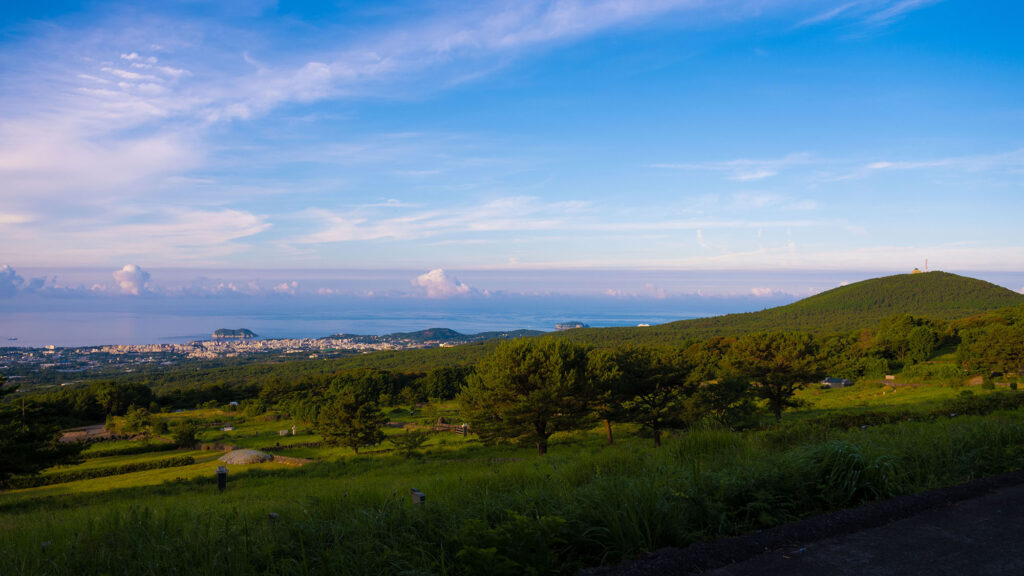
☞ Just a brief guide to the seven Hallasan trails.
Inside Hallasan National Park, the hiking routes are commonly referred to as the “seven trails.” This can be slightly misleading, as only two of them actually reach the summit crater of Hallasan. The remaining routes do not ascend to the top, but instead traverse the lower and mid-mountain zones, each offering a distinct hiking experience in terms of distance, terrain, and scenery.
The two summit routes are Seongpanak Trail and Gwaneumsa Trail. Seongpanak is the longer, more gradual ascent and is the most frequently used route to the summit crater at Baengnokdam. Gwaneumsa, by contrast, is steeper and more demanding, with rugged sections, valley crossings, and exposed ridgelines, though it is often regarded as the more scenic of the two.
Beyond the summit routes, there are three mid-mountain trails: Eorimok, Yeongsil, and Donnaeko. These do not reach the summit but allow access to Hallasan’s upper slopes and volcanic terrain. Eorimok is known for its broad alpine views, Yeongsil for its striking rock formations, and Donnaeko for its quieter, forested southern approach.
The remaining two routes are Eoseungsaengak Trail and the Seokgulam area forest paths. Eoseungsaengak is a short volcanic cone trail offering panoramic views over Jeju, while the Seokgulam area paths are quieter forest walking routes located on the lower slopes of Hallasan, included in some trail classifications for their accessibility and local significance.
In summary, the “seven trails” of Hallasan are not seven equivalent summit routes, but rather a structured network of paths ranging from full ascents to short volcanic and forest walks, each revealing a different layer of the mountain.
Today’s climb was planned via the Donnaeko Trail towards Witse Oreum, a route of approximately 9.1 km, usually completed in around 4 hours and 30 minutes at a steady pace.
We set off at dawn, driving towards the starting point while the sky slowly shifted through soft tones of gold, blue, and pale orange. By the time we arrived, the light had fully broken, and we began our hike at 6:00 am to avoid the stronger heat later in the day.
The Donnaeko trailhead, located within Hallasan National Park, is relatively understated. A small parking area sits a short distance from the actual entrance, and unlike the more developed access points, there is no defined visitor hub. The atmosphere is immediately quieter and more secluded.
The trail begins along the southern slopes of Hallasan, where the surroundings are densely forested and largely undisturbed. From the outset, there is a noticeable absence of crowds and infrastructure, giving the route a more remote feel, despite being part of a maintained national park system.
Even before reaching the main entrance, we were met with a quiet moment as Korean water deer grazed nearby. We took it as a gentle welcome. As we entered the trail proper, the path was relatively easy and well-defined, with the forest closely surrounding us. Not long after, we encountered a mother deer with her three fawns, a rare sight for us. We kept our distance, observing quietly. The mother remained watchful, but calm. It was a brief and respectful encounter, and we moved on without disturbing them.
As the climb continued, the trail began to change. Wooden steps appeared frequently, some showing signs of wear, with sections where nature seemed to be slowly reclaiming the path. The forest grew denser, the light more limited, and the atmosphere noticeably more enclosed. Sounds carried more clearly, movement in the trees, rustling in the undergrowth, and occasional noise beneath the steps themselves.
The trail felt largely unspoilt. While we had encountered similar conditions during our BAC 100 Peaks Challenge, Donnaeko felt more enclosed and less predictable. The path narrowed in places, and the dense vegetation created a sense of limited visibility. Deer are common here, but the possibility of snakes, also known to inhabit the area, added a level of caution. We found ourselves tapping our hiking poles more deliberately, making our presence known as we moved through the forest.
Progress felt slow. The trail twisted frequently, and with little variation in scenery, it created the impression of moving in circles. Time passed without clear markers of advancement, and the climb felt longer than expected.
Facilities along this route are minimal. Aside from the entrance, there is only one basic restroom located before reaching the Nambyeok junction. It is a simple structure, without water supply or toilet paper, so carrying your own essentials is necessary.
Not long before reaching this point, I began to feel unwell. The combination of heat, exertion, and possibly mild altitude effects caused a headache that quickly worsened, followed by nausea. By the time we reached the restroom area, I was no longer able to continue comfortably. We stopped for nearly an hour to rest.
While recovering, we noticed a partial view of Hallasan’s Nambyeok. Even in that condition, the scenery was enough to pause and take a few photos. It was a reminder of how powerful even a brief view can be.
Given the situation, we made the decision to turn back. We were still about an hour away from Witse Oreum, and continuing would not have been safe or enjoyable. Instead, we marked the point and planned to return another time, possibly approaching from the Yeongsil side and connecting through Witse Oreum before descending towards this section.
The descent was long but steady. As we went down, I gradually began to recover, suggesting that the issue was likely a combination of heat and exhaustion rather than altitude alone.
Near the end of the trail, we encountered another deer, feeding quietly near the exit. It felt less like a welcome and more like a quiet reminder. This is their space first.
Looking back, the Donnaeko Trail offers a very different experience from the more popular Hallasan routes. It is less developed, more enclosed, and noticeably quieter. At times, it can feel isolating, but that is also what allows it to remain largely unspoilt.
During the climb, I found myself wishing for more facilities, benches, rest areas, small conveniences. In hindsight, those absences serve a purpose. This section of the mountain supports wildlife precisely because it remains less altered.
We did not complete the route this time, but the experience offered something just as valuable. It reinforced the importance of respecting natural habitats and recognising that not every trail is designed for comfort. Some are meant to remain as they are.
For now, we leave Donnaeko as it is, quiet, demanding, and largely untouched.